
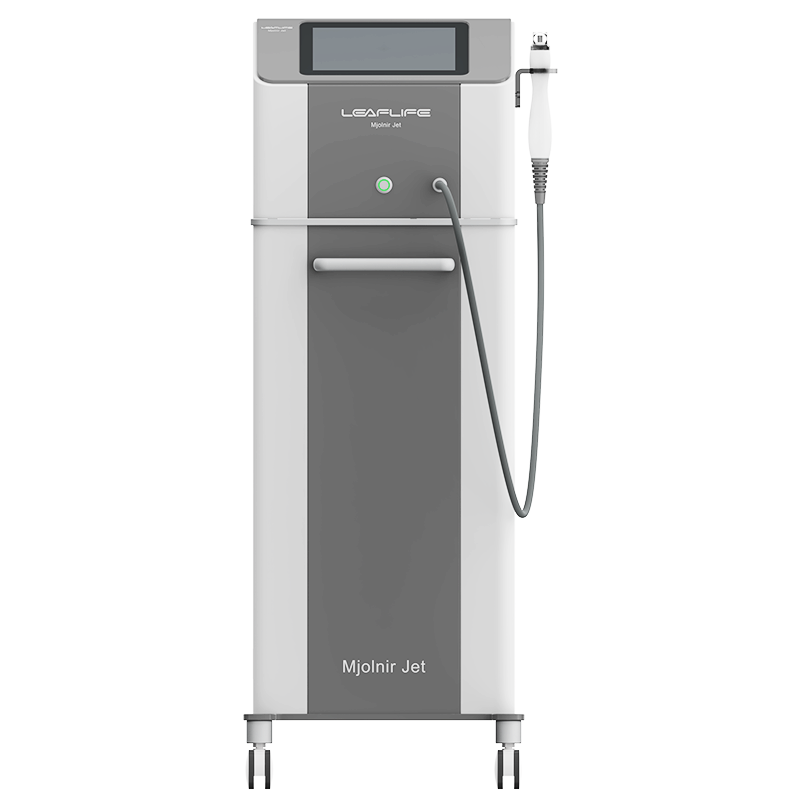
Mjolnir Jet
Revolutionizing Wound Care with Cold Plasma Technology Precision Healing, Contact-Free Innovation.
The Mjolnir Jet is a revolutionary argon cold plasma device that redefines wound care in surgery and wound care centers. It delivers a threefold effect: sterilization, enhanced microcirculation, and accelerated wound closure—improving outcomes, shortening recovery, and reducing costs.
- Technology: Utilizes a precise, low-temperature argon plasma stream.
- Triple-Action Efficacy: Achieves sterilization, enhances microcirculation, and accelerates wound closure.
- Clinical Benefits: Improves patient outcomes and reduces recovery time.
- Economic Value: Helps lower the overall cost of long-term wound care.
Wide area of applications

The Mjolnir Jet is developed for the treatment of chronic wounds and infectious diseases of the skin and skin appendages on the extremities and torso. Its precision cold plasma technology makes it a versatile tool for a wide range of challenging indications, including:
Leg Ulcers (e.g., venous or arterial)
Diabetic Foot Ulcers
Decubitus Ulcers (Pressure Injuries)
Postoperative Wound Infections
Wounds with Local Signs of Infection
Wounds that are unresponsive to conventional treatment, exhibit a healing disorder, or are at risk of developing one
Furthermore, the device can be effectively utilized for the treatment of various skin diseases caused by pathogens.
Selective & Beneficial – Why It’s Safe and Promotes Healing
Unmatched Safety through Selective Action
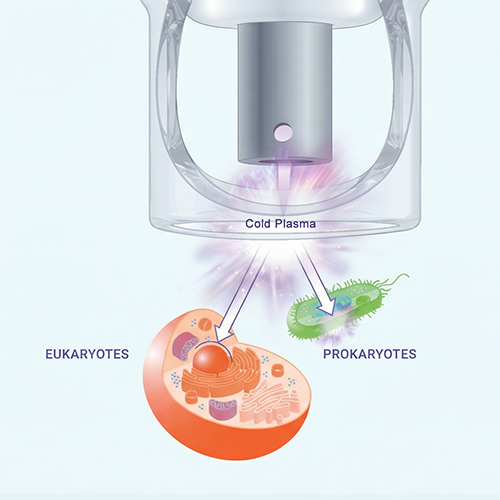
The safety of cold plasma stems from a fundamental biological disparity between human cells and pathogens, combined with precise physical control. Human cells possess robust antioxidant defenses (like SOD and Glutathione) that easily neutralize the controlled, low-dose reactive particles from the plasma. In contrast, microbes lack such protection, leading to their rapid inactivation. This selective effect is further ensured by the plasma’s inherent low temperature (<40°C) and superficial, time-limited application, which protects deeper healthy tissue.
Activating the Body’s Natural Healing Pathways
Beyond safety, the same reactive species that eliminate pathogens at higher doses act as crucial signaling molecules at therapeutic levels. This principle, known as hormesis, triggers beneficial adaptive responses in human tissue. Specifically, cold plasma stimulates key cellular repair pathways, promotes the release of growth factors (such as VEGF for angiogenesis), and helps modulate the wound immune environment. Thus, it not only clears infection but also actively creates optimal conditions for regeneration.
Promotes and Supports the Wound Healing Processes
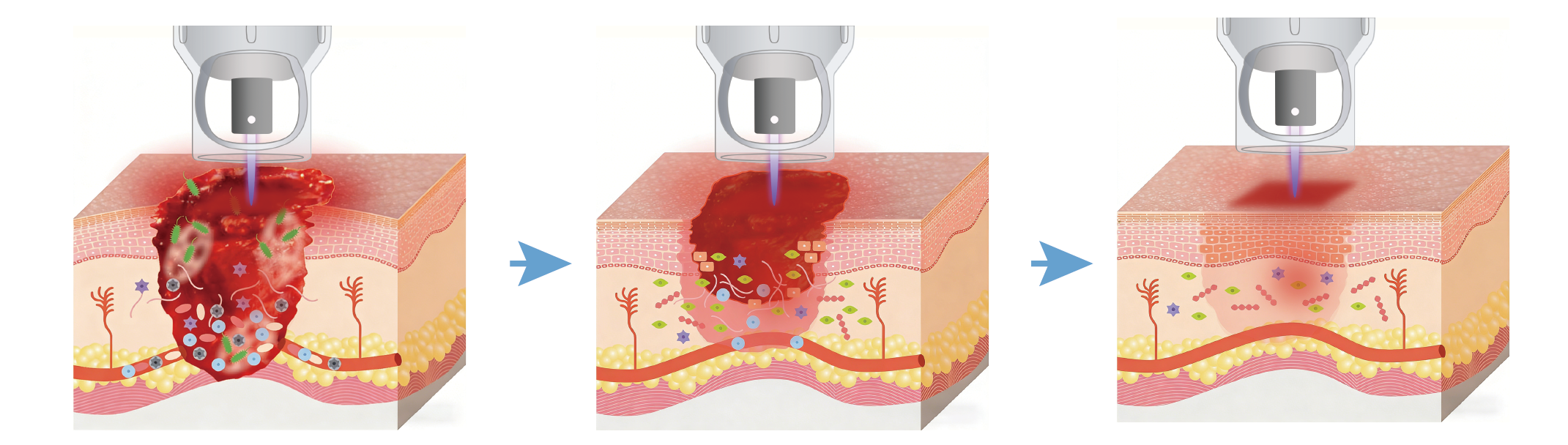

Exudation phase
- Initiates the healing process.
- Has an anti-inflammatory and anti-bacterial effecton on the wound surface, which can be expected to reduce the risk of new infections.
- Inactivates a wide range of micro-organisms such as multi-resistant pathogens.

Exudation phase
- Stimulates the generation of new cells down to the deeper skin layers.
- Improves micro-circulation and thus the supply of the tissue with oxygen and nutrients
- Promotes the generation of new blood vessels (angiogenesis), proteins and tissue structures

Epithelialisation phase
- Stimulates the tissue regeneration processes up to the potential wound closure
Parameters
| Parameter | Specification |
|---|---|
| Cold Plasma Temperature | < 40°C |
| Output Power | 8 W |
| Power Level | 1-5 levels |
| Mode of Operation | Continuous |
| Working Gas | Argon |
| Gas Tank Pressure | 125-135 bar (~100%) |
| Air Flow Settings | 4-6 cm³/s |
| Mainframe Dimensions (L x W x H) | 430 mm x 235 mm x 315 mm |
| Dimensions with Trolley (L x W x H) | 430 mm x 400 mm x 1180 mm |
| Net Weight (without gas cylinder) | 32 kg |
| Total Weight (with gas cylinder) | 55 kg |
Frequently Asked Questions
1. Q: What does the treatment feel like? Is it painful?
A: Most patients report only a mild, localized warming or tingling sensation. The procedure is generally well-tolerated without the need for anesthesia.
2. Q: How many treatment sessions are needed?
A: There is no fixed number. The treatment course is individualized, continuing until the wound shows robust signs of healing—infection controlled, healthy granulation tissue present, and wound size reducing.
3. Q: What’s the difference between this and ultraviolet (UV) light disinfection?
A: While both use physical methods, cold plasma is far more comprehensive. Its active particles have better penetration over complex surfaces (like wound cavities) than UV light alone. Crucially, cold plasma provides added biological benefits (improved circulation, cell stimulation) that UV light does not.
4. Q: Is it safe for patients with diabetes?
A: Yes. Its non-invasive nature and ability to improve microcirculation make it a particularly suitable and safe adjunct therapy for managing diabetic foot ulcers, where blood flow and infection are major concerns.
5. Q: During treatment, will I smell anything or feel a sting?
A: You may notice a faint, mild metallic odor, similar to the air after a thunderstorm, which is normal and comes from the generation of ozone and other reactive species in the air. Most patients do not feel a sting; the sensation is typically described as a gentle warmth or tingling on the skin. This is due to the non-thermal nature of the cold plasma (<40°C).
6. Q: Can cold plasma therapy create bacteria that are “super-resistant”?
A: No, this is a key advantage. Unlike antibiotics that target specific bacterial pathways (which can mutate), cold plasma uses multiple simultaneous physical and chemical attacks (e.g., disrupting cell membranes and oxidizing internal components). It is very difficult for microbes to develop defenses against this broad-spectrum, multi-target mechanism, making resistance highly unlikely.
7. Q: How does it help with wounds that have a sticky film (biofilm)?
A: Cold plasma is particularly effective against biofilms. The reactive particles can penetrate the protective extracellular matrix of the biofilm. They then simultaneously kill the embedded bacteria and degrade the sticky film structure itself. This “physical debridement” effect is something traditional antibiotics and chemical antiseptics often fail to achieve.
8. Q: Is there any risk of radiation or long-term side effects?
A: The technology is extremely safe with no known long-term side effects. The weak UV radiation generated is localized, very low-dose, and entirely contained within the therapeutic beam; it does not pose a radiation hazard. The effect is purely superficial. Clinical studies have not observed any systemic adverse effects or long-term complications from proper use.
Contact Us
We are actively looking for Distributors and Dealers, more favorable prices, and discounts. If interested, contact us soon
Mjolnirjet will use the information to respond to your request in accordance with our Privacy Policy.